How to Choose a Custom Cabinetmaker in Palm Beach County
A buyer's guide. What to ask the shop. What to ignore in the marketing. How to spot the difference between a real fabricator and a reseller pretending. Written for homeowners and the designers advising them.
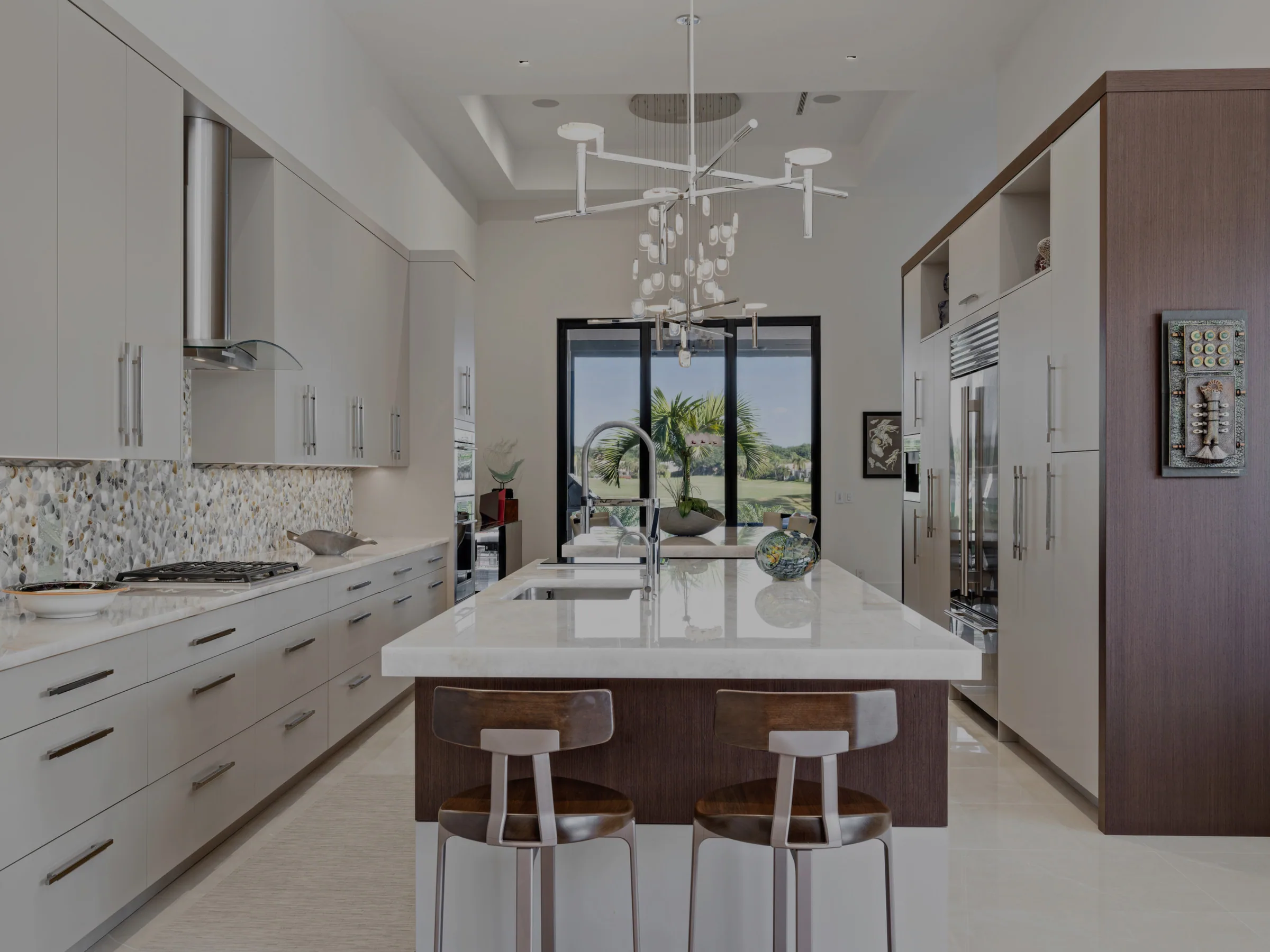
There are perhaps a dozen shops in Palm Beach County that present themselves as custom cabinetmakers. Some of them are. Some of them are showrooms attached to wholesale lines. Some of them are designers who outsource the fabrication. The work that comes out of each is materially different, even when the marketing reads the same.
This is a guide for sorting through them. It is written for homeowners commissioning their first custom kitchen and for designers vetting a new fabricator. The advice applies anywhere, but the South Florida market has its own quirks that make a few of these questions more important here than they would be in, say, Connecticut.
Question 1: Where is the work actually fabricated?
This is the first question, and the answer should be a single physical address you can drive to. Real custom shops fabricate in their own facility. They have a saw shop, a finish room, a clamp area, a benchwork area, and a small office. You can visit. You can see the work in progress. You can meet the people who will build your cabinetry.
If the answer is “we work with several partner fabricators” or “our craftsmen are spread across the region” or any variation on that theme, the shop is not fabricating. It is reselling. There is nothing inherently wrong with reselling, but reselling and custom fabrication are different services at different price points, and a reseller selling at custom-fabrication prices is a problem.
A real shop will invite you to walk through. We do that here. The shop is in Jupiter and the door is open by appointment. When you arrive, the team is usually at the benches or drafting table, working.
Question 2: Who designs the cabinetry?
In a real custom shop, the design discipline is owned by the people who run the shop, not delegated to a separate department or outsourced. At our shop, that discipline traces back to Sergio Sartor Sr., the founder, who set the standards the shop holds today. The same is true at the other genuine custom shops in the region.
If the answer is “we have a designer on staff who handles the design” and that designer is not also the principal, ask follow-up questions. Sometimes the answer is fine: a senior designer who has been with the shop for fifteen years is a real answer. Sometimes the answer is a recent design-school hire who works from a software template and has never built a cabinet. The latter is a tell. Custom design that does not come from someone who builds is design that has not been engineered. The shop floor will discover problems the designer did not catch, and the homeowner pays for the change orders.
Question 3: Who installs the work?
The install crew should be the build crew. Same people. They built the cabinetry, they know how it goes together, they handle the scribing and shimming on irregular walls, and they take responsibility for the punch-list.
If the install is subcontracted, the shop has lost half its accountability. The fabricator can blame the installer for damage. The installer can blame the fabricator for fit issues. The homeowner is in the middle. Trade-quality custom shops keep install in-house for exactly this reason.
Question 4: What is the joinery in the drawer boxes?
This is the simplest material test of a custom shop. Ask to see a sample drawer box from a recent project. The answer should be solid wood (typically maple, baltic birch ply, or hardwood-grade ply for the box panels) with dovetail joinery at the corners. The bottom should be 1/4-inch hardwood ply, captured in a dado, not stapled to the underside.
If the drawer box is melamine-faced particleboard, screwed at the corners, with a stapled-on bottom, the shop is selling production cabinetry at custom prices. Production cabinetry is fine for the right project at the right price. It is not custom.
Question 5: What finish system?
Ask what the topcoat is. Real custom shops use conversion varnish, catalyzed lacquer built up in coats, or hand-rubbed oil finishes for furniture-grade pieces. Production shops use factory-baked single-pass coatings.
In South Florida specifically, ask about humidity performance. The right answer references coastal-climate-tested finish systems and discusses how the shop preps substrates (sealing endgrain, sanding between coats, finishing the back side of doors and panels). The wrong answer is “we use the same finishes everyone uses” or any variant on the same theme. South Florida is a finish-killer for shops that do not adapt to the climate.
Question 6: Lead time and pricing
A custom kitchen takes 12 to 16 weeks from approved drawings. A custom primary bath takes 8 to 12 weeks. Architectural millwork packages run 10 to 16 weeks per room. Anyone promising a real custom kitchen in eight weeks is either lying or selling production cabinetry under a custom label.
Pricing varies by scope, materials, complexity of joinery, finish, hardware, and integrated appliances. A real shop will give you a firm number after the design consultation, not on a phone call. Expect the consultation to require a clear sense of the project before any pricing conversation begins.
If a quoted number seems suspiciously low for a custom kitchen of the scale you are considering, it usually is. We have a separate piece on the difference between custom, semi-custom, and stock cabinetry if you want to read more about why the categories sit at meaningfully different price points.
Red flags
A short list of things that should make you walk away:
- The shop will not let you visit the fabrication facility, or there is no fabrication facility to visit.
- The shop principal is not the person designing your project.
- The install crew is subcontracted.
- Drawer boxes are melamine-faced particleboard, stapled.
- The shop quotes a firm price on a phone call without having seen your space.
- The shop promises lead times that are dramatically shorter than the trade norm.
- The shop has no written warranty on the cabinet boxes.
- The shop cannot explain how their finish system is engineered for South Florida humidity.
Green flags
What to look for in a shop you are seriously considering:
- A physical fabrication facility you can visit.
- A shop principal who is also the designer.
- An in-house install crew.
- Drawer boxes built in solid wood or hardwood-grade ply with dovetail joinery.
- A finish system you can ask specific questions about and get specific answers.
- A written structural warranty (we offer 25 years on cabinet boxes).
- Lead times that match the trade norm.
- Recent completed projects you can ask about (and ideally visit, with the homeowner’s permission).
A note on referrals
Most of the work in our shop comes from referrals: past clients, designers we have worked with, builders who have built around our cabinetry. That is true of most legitimate custom shops in this market. The implication for a buyer is that the best information about a shop is going to come from someone who has actually used them, not from a website or a marketing brochure. Ask your designer, your architect, or your contractor who they trust. Ask homeowners in your community. Reputation in custom cabinetry travels by word of mouth because the work is too important to leave to chance.
If you would like to talk through a project, contact us. Consultations are by appointment, with the team that builds the work.
Related: About the shop · For Designers and Architects